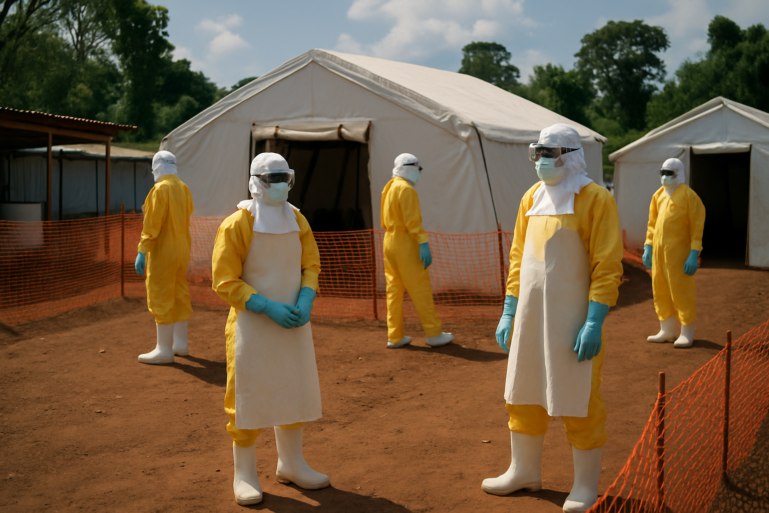
The Democratic Republic of the Congo has recorded 6,186 confirmed Ebola cases and 3,007 deaths in an outbreak that has become the country’s largest and deadliest epidemic of the disease, according to the latest government figures.
The totals cover cases recorded through August 31, 2026, and were published by the country’s National Institute of Public Health in Situation Report No. 109 on September 2. The same figures were independently reported by The Associated Press and Reuters.
The epidemic, caused by the Bundibugyo species of Ebola virus, has reached 60 health zones across six provinces. Its scale makes it the world’s second-largest recorded Ebola epidemic, behind only the outbreak that struck West Africa from 2014 to 2016.
WHO calls outbreak the fastest-moving on record
World Health Organization Director-General Tedros Adhanom Ghebreyesus warned member states about the speed and breadth of the crisis during a high-level briefing on September 1. At the time, he said the outbreak had passed 6,000 reported cases, with almost 3,000 deaths.
“The Ebola epidemic in the Democratic Republic of the Congo is already the second-largest on record, and the fastest-moving that we have ever seen,” Tedros said in remarks published by the WHO.
His comments reflected the rounded totals available before the National Institute of Public Health released its more detailed situation report the following day. The government document placed the confirmed caseload 186 above the 6,000 threshold and the death toll seven above 3,000 as of the end of August.
The epidemic’s presence in 60 health zones across six provinces also marks it as the most geographically extensive Ebola emergency documented in the country under the figures released by the government and WHO. The verified reports did not provide a province-by-province breakdown alongside the national totals.
No licensed vaccine for Bundibugyo disease
The species responsible for the outbreak presents a significant limitation for medical countermeasures. The WHO says there is no licensed vaccine or approved specific treatment targeting Bundibugyo virus disease. Candidate vaccines and treatments are being evaluated, but they have not received the licensed or approved status that would make them established, species-specific countermeasures.
The distinction is central to the current emergency: the confirmed outbreak is specifically attributed to Bundibugyo virus, and the WHO’s assessment of available tools applies to that form of Ebola virus disease. The agency has not indicated that a licensed vaccine or approved targeted treatment for Bundibugyo disease is currently available.
Emergency designation remains in place
The WHO reported that the outbreak remained a Public Health Emergency of International Concern as of August 28. The designation was still in force just days before Tedros addressed member states and before Congo’s public health institute published the new national tally.
The sequence of official updates provides an increasingly precise picture of the outbreak at the end of August. The WHO’s August 28 emergency status was followed by Tedros’s September 1 warning that infections had exceeded 6,000 and deaths were approaching 3,000. The September 2 government report then confirmed that both thresholds had been crossed in data through August 31.
With 6,186 confirmed cases, the outbreak now stands as the largest Ebola epidemic ever recorded in the Democratic Republic of the Congo. Its 3,007 deaths also make it the country’s deadliest. Globally, only the 2014–2016 West Africa epidemic remains larger in the historical record cited by health authorities.
The latest totals establish the scale of the emergency at the close of August, while the continuing evaluation of candidate countermeasures underscores the absence of a licensed vaccine or approved specific therapy directed at the Bundibugyo species.