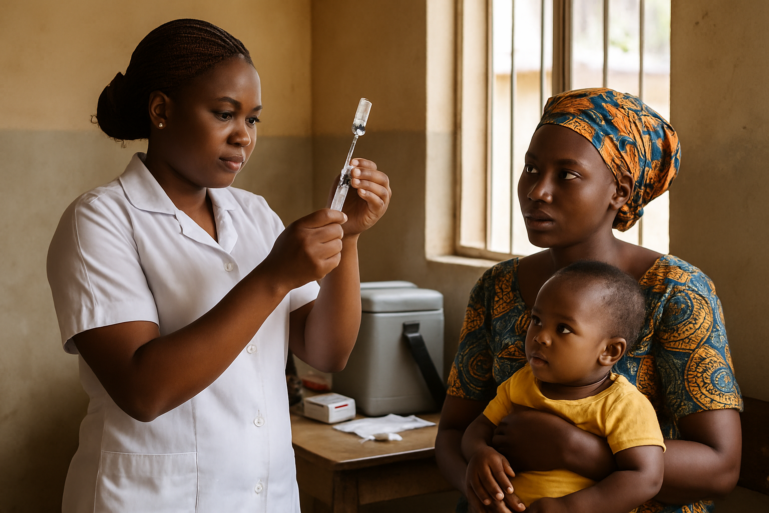
ABUJA — Ninety-three percent of children affected by recent diphtheria outbreaks in Nigeria had not been fully vaccinated, according to the head of the country’s National Primary Health Care Development Agency.
Dr. Muyi Aina, the agency’s executive director and chief executive officer, disclosed the figure during a quarterly media briefing in Abuja on Oct. 15, 2026. He said the vaccination records of affected children showed that some had received none of the relevant vaccine doses, while others had received only one of the three recommended doses.
“Over 90 per cent, I think 93 per cent, of the children had not received the full complement of vaccines that they should receive,” Aina said, according to Galaxy TV.
The figure places missed or incomplete vaccination at the center of the government’s account of the recent outbreaks. It also distinguishes between children who had never received the vaccine and those whose vaccination had begun but was not completed.
Aina partly blamed the gaps on misinformation and false rumors that discouraged people in some communities from accepting vaccines that were available. His remarks connected the diphtheria cases not only to access or delivery issues but also to public confidence in vaccination.
Incomplete doses highlighted
The three-dose recommendation was a key point in Aina’s explanation. Receiving a first dose did not amount to completing the vaccination course, and children with only one dose were included among those who lacked the full complement.
That distinction is important when assessing vaccination figures. A record showing that a child received one injection does not necessarily indicate that the child completed the recommended series. Aina’s comments suggest that both non-vaccination and failure to return for later doses contributed to the high percentage reported among affected children.
The briefing did not present the vaccination gap as uniform in every community. Instead, Aina referred to misinformation and rumors as factors that had influenced vaccine use in some areas. The comments indicate that making doses available does not by itself ensure that families will bring children forward or complete every recommended dose.
The agency’s public account also puts renewed attention on how vaccination coverage is measured. Numbers for initial doses, completed courses and the vaccination status of children who become ill describe different aspects of a campaign. In the diphtheria outbreaks discussed by Aina, the government’s headline figure concerned completion: 93% of affected children had not received all recommended doses.
Large campaigns for other vaccines
The diphtheria disclosure came as the agency reported substantial totals from other immunization programs. More than 18.3 million girls had received the human papillomavirus vaccine, according to figures independently reported by Galaxy TV and New Telegraph.
More than 102 million children between the ages of nine months and 14 years had also received the measles-rubella vaccine, the two outlets reported. The figures show the scale of recent vaccination activity, although they cover different vaccines and populations from the children discussed in connection with diphtheria.
Separately, 882,000 children in Kebbi, Bayelsa, Ondo and Bauchi states had received at least the first dose of the malaria vaccine, according to reports by Galaxy TV and Tribune Online. The wording of that figure identifies first-dose reach rather than completion of every recommended dose.
Taken together, the numbers offer two views of Nigeria’s vaccination efforts: broad reach through large campaigns and persistent gaps among children who have received no doses or only part of a recommended course. The diphtheria data emphasize the latter problem, with Aina saying that nearly all affected children lacked full vaccination.
His attribution of some missed doses to false information also points to a challenge beyond vaccine supply. Communities may have access to vaccines while still facing rumors that affect whether parents and caregivers use them. Addressing those concerns is particularly relevant where a vaccine requires multiple visits to complete the recommended course.
For the National Primary Health Care Development Agency, the reported 93% figure provides a clear measure of the vaccination shortfall among children caught in the recent diphtheria outbreaks. It also sharpens the difference between starting a vaccination series and completing it — a gap that Aina said was evident in the records of the children affected.