KAMPALA, Uganda — Uganda and the United States have signed an agreement establishing how the two countries will cooperate on health programmes through 2030, including planned US support of up to $1.7 billion and a Ugandan commitment to raise domestic health spending by $577 million.
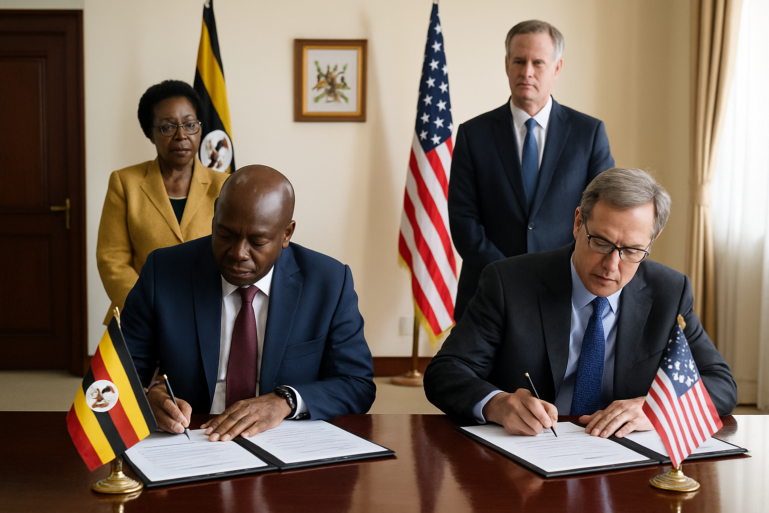
The Strategic Objective Agreement was signed on September 3, 2026, at Uganda’s Ministry of Finance, Planning and Economic Development in Kampala. It puts into operation the bilateral health Memorandum of Understanding that the two governments signed on December 10, 2025.
Henry Musasizi, Uganda’s Minister of State for Finance, Planning and Economic Development for General Duties, signed for Uganda. US Embassy Chargé d’Affaires Mikael Cleverley signed on behalf of the United States.
The framework covers cooperation from 2026 through 2030 and sets out a shared approach to preventing, detecting and responding to existing and emerging infectious-disease threats. Confirmed priorities include HIV/AIDS, tuberculosis, malaria, outbreak management, public-health surveillance, health-workforce capacity and supply chains for health commodities.
US support paired with higher Ugandan spending
Under the underlying five-year memorandum, the United States plans to provide up to $1.7 billion in health assistance. Uganda, in turn, pledged to increase its domestic health expenditure by $577 million during the framework period.
Musasizi said the country recognised the need to commit more of its own resources to the sector alongside external assistance.
“The Government of Uganda acknowledges that sustainable health outcomes require increased domestic financing,” he said at the signing ceremony, according to Nile Post.
The domestic spending commitment is a central part of the bilateral arrangement. It places Uganda’s own health financing alongside continued US assistance rather than treating external support as the only funding component of the five-year programme.
The cooperation encompasses both long-running disease priorities and broader systems needed to manage health threats. HIV/AIDS, tuberculosis and malaria remain specifically identified areas, while surveillance and outbreak response are intended to strengthen the country’s ability to detect and manage public-health emergencies. Health-worker capacity and commodity supply chains are also included in the agreed scope.
Reflecting on previous health cooperation, Musasizi said: “These interventions have saved lives, strengthened communities and enhanced Uganda’s capacity to respond to public-health emergencies.”
Greater use of government-to-government financing
A significant feature of the new arrangement is the planned shift in how US health assistance is delivered. The framework is intended to move a substantial share of support away from predominantly off-budget implementation and toward government-to-government financing routed through Uganda’s Ministry of Finance.
The change gives Uganda’s public financial system a larger role in handling bilateral health assistance. However, the available agreement details do not establish that every dollar of the planned US contribution will be transferred directly to the Ugandan government. The commitment should therefore not be interpreted as a pledge that the entire amount will become direct budget financing.
The Strategic Objective Agreement provides the operating framework for the broader memorandum, translating the commitments made in December 2025 into a structure for cooperation over the five-year period. The two documents are connected but serve different purposes: the memorandum records the overall funding and policy commitments, while the September agreement formalises the framework for implementing them.
For Uganda, the arrangement combines continued external support with a quantified commitment to expand domestic expenditure. For the United States, it maintains a major role in supporting infectious-disease programmes and public-health systems while increasing the use of bilateral government financing.
The agreement’s impact will depend on implementation through 2030, including how the planned US assistance is allocated, how Uganda fulfils its additional spending pledge and how financing reaches the identified priority areas. The signed framework establishes the scope and intended funding levels, but the US commitment remains stated as support of up to $1.7 billion over five years.