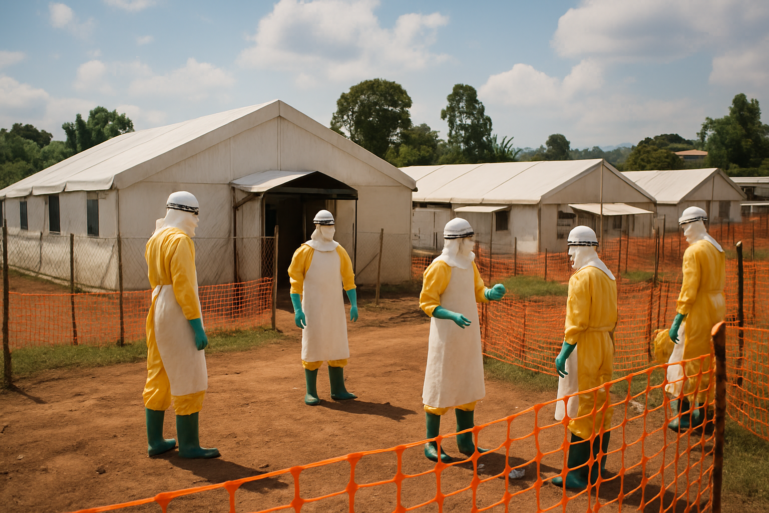
BUTEMBO, Democratic Republic of the Congo — North Kivu has emerged as a major centre of the country’s Ebola outbreak, with every operational bed occupied at one Butembo treatment facility and health authorities opening additional centres as infections shift into areas that were less prepared.
All 29 beds at the Kitatumba Ebola treatment centre in Butembo were occupied during the week ending September 25, 2026, Reuters reported from the facility. Authorities opened two more Ebola treatment centres in the city during the same week, bringing Butembo’s total to four.
The expansion underscores the immediate pressure on treatment capacity in North Kivu. Stephanie Hoffmann, the Médecins Sans Frontières project coordinator in Butembo, told Reuters: “There are sometimes patients who know they have Ebola but cannot find a bed.”
Outbreak shifts toward North Kivu
A World Health Organization assessment issued on September 20 found that North Kivu accounted for about one-third of newly confirmed cases and deaths. That proportion refers to the assessment’s reporting period, rather than the province’s share of all cases recorded since the outbreak began.
Médecins Sans Frontières, also known as Doctors Without Borders, had warned two days earlier that transmission was moving from parts of Ituri into less-prepared areas. In its September 18 assessment, the medical organization said North Kivu accounted for nearly half of newly confirmed cases at that time.
The one-third and nearly-half figures cover separate reporting snapshots and should not be treated as contradictory measures of the same period. Together, however, they show that North Kivu had become an important emerging hotspot as the geographic focus of transmission changed.
“The outbreak is not shrinking — it is moving,” Anthony Kergosien, the MSF emergency coordinator in the Democratic Republic of the Congo, said in the organization’s September 18 statement.
Earlier WHO data also showed the severity of the outbreak in North Kivu. As of September 7, the province had recorded exactly 1,066 confirmed cases, including 453 reported during the preceding 21 days. Its confirmed-case fatality ratio stood at 65.4%.
National case count continues to rise
Government data cited by Reuters showed that the Democratic Republic of the Congo had recorded exactly 7,820 confirmed cases and 3,779 deaths as of September 22. Those figures marked substantial continued growth from the totals reported by WHO for September 7, when the country had 6,757 confirmed cases and 3,267 deaths.
The national confirmed-case fatality ratio was 48.3% in WHO’s September 7 report, considerably below the 65.4% ratio documented in North Kivu at that time. Case fatality ratios can change as an outbreak develops and additional cases and outcomes are reported, but the figures independently indicate that North Kivu was experiencing a particularly high proportion of reported deaths among confirmed cases.
WHO identified Bundibugyo virus as the pathogen responsible for the outbreak. As of September 10, the agency said there was no approved vaccine or specific treatment for Bundibugyo virus disease. That limitation places added importance on the availability of treatment-centre beds as case numbers rise, although the verified assessments did not provide projections for future capacity needs.
The opening of two additional centres in Butembo increased the number of facilities available in the city, but the situation at Kitatumba showed that operational capacity was already under strain during the final full week of September. The reports did not specify the number of beds available at the three other Butembo centres.
With the national total continuing to increase and a large share of recent infections concentrated in North Kivu, the latest assessments point to a changing outbreak rather than a uniformly declining one. Differences between reporting periods will remain important when comparing the province’s share of new cases, while the occupied beds in Butembo provide a direct measure of pressure on the local response.